Michele Loffredo: In a world celebrating the triumph of aesthetics and the cult of beauty, one paradoxically witnesses the disappearance of the artwork as a source of unique and unclassifiable experience: art has evaporated into an aesthetic ether. The root of this process is the progressive negation of the work as object, replaced by processes and devices that manufacture experiences. A process begun by Marcel Duchamp when, in 1913, he created his first readymade, the Bicycle Wheel, and in 1916 constructed A Bruit secret — a semi‑readymade comprising two brass plates and a ball of string containing a “secret object” chosen by his patron Walter Arensberg. You have made that work a programme for your exhibition because of its particular meaning…
Fabrizio Ruggiero: Duchamp’s invention reflects, applied to art, a notion of metaphysical experience expressed in the Vedanta: our experience of the real is conditioned by how we conceive it, and we are free to conceive it as we wish. What, then, is an artwork? One says that it is the product of an artist… but who is an artist? The one who produces artworks. It is a sort of vicious circle in which work and artist support one another by virtue of a third thing from which they also take their name — art.
M.L.: The layout of the exhibition exploits not only the spatial but also the symbolic potential of the little deconsecrated church of San Lorenzo. Rectangular in plan, it still preserves the central altar but has been purged of liturgical signs. Used in recent years as a white‑box gallery for contemporary art, you have not only utilised it as such but have restored it to its original function. Invested with a “sacred” mise‑en‑scène, albeit in an ambiguously secular register, it presents ten portraits of contemporary artists on the walls as so many icons of art, converging toward the centre on the painting A Bruit secret & Pandora’s box, placed in the large niche of the altarpiece.
F.R.: When you shake A Bruit secret you hear a sound, but no one knows what produces it. Duchamp produced in 1964, with Arturo Schwarz’s gallery, a limited edition of his most famous readymades. In 1987 a Florentine friend showed me some of these works he had just purchased from Schwarz, and I had the occasion to hold A Bruit secret in my hands. For me it is a fine metaphor for art.
M.L.: The exhibition revolves around A Bruit secret & Pandora’s box as a metaphor for art, for its presence/absence — presence as absence — its hiding/appearing, for the possibility of perceiving “something” but not defining it.
F.R.: A Bruit secret is indeed a good metaphor and recalls the mutable aspects of a mythical symbol: Pandora’s vessel. In Italy Pandora’s myth is always associated with a vase containing, in its most familiar version, all the evils that are released when the vase is opened. In English, French and German, thanks to an interpretation by Erasmus of Rotterdam, the vase becomes a box (Box, boîte, Büchse), an interpretation that fascinated artists such as Paul Klee and Max Beckmann. This difference created a different iconography. According to the myth, when the vessel is opened only Hope remains within; art is also hope.
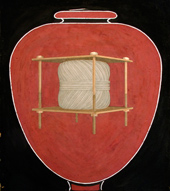
M.L.: In the painting A Bruit secret & Pandora’s box the depiction of Duchamp’s readymade is set within a circular trace, Pandora’s jar. One cannot help but note the contrast between the three‑dimensionality of A Bruit secret and the two‑dimensional construction of the vessel on a Pompeian red ground, recalling the simplicity of ancient painting. Here the mark is above all a symbol, and one readily perceives analogies with the vessel and its hidden, mysterious receptacle.
F.R.: By painting a fresco of A Bruit secret within Pandora’s jar I have constructed a koan, the instrument of a Zen meditative practice — a paradoxical statement used to awaken profound awareness. Listening to the secret sound of a painting seems to me a good way to lead the mind, through a painting, out of the mechanism of thought. Painting and sculpture demand an active approach: the viewer’s eye is free to wander across the work for as long as he wishes, perhaps attracted by a detail that can open up a new world. A spatial object does not demand to be read in a predetermined order; one can begin from different points and vary meaning or tempo, letting the gaze roam with choiceless attention and allowing vision to perceive beyond the selective reactions of conditioned thought. Visual perception, the development of awareness through sight, is different from the word that relates it; one cannot say painting — one can only speak around it.
M.L.: I know you used a particular technique for A Bruit secret & Pandora’s box…
F.R.: I constructed a virtual model which I then lit, posed and photographed from various angles. From the resulting images I chose one for the cartoons of the fresco and used two different perspectives for the rice‑paper prints.
M.L.: A Bruit secret & Pandora’s box crowns the entire installation, ringed by effigies of some of the most significant contemporary artists through whom the history of art has passed — thaumaturges who, with their miraculous “touch,” transformed art. In your portraits of these artists you have used the fresco technique that you adopted from the beginning of your career. I notice these images are always cropped, that some part always falls outside the limits of the painting…
F.R.: That is true, though less evident in those of Burri and de Chirico where the hair blends with the background. I prefer to call them effigies rather than portraits — symbolic images rather than veristic representations. Fingere, as well as “shaping or moulding,” also means “to represent in relief,” which is literally evident when one observes the pictorial surface of my paintings. In Greek mythology there is a particular type of effigy, the kolossos, with a dual function: it translates the power and soul of the dead into visible form and, at the same time, inserts that power into the universe of the living. The kolossos not only seeks to evoke the symbolic potency to which it refers, but above all to establish a true communication with it, inserting its presence into the human realm. At the same time kolossalisch denotes something that, not necessarily by scale, is almost too large, always exceeds the right measure and goes beyond the limit — and which, because of its excessive size, remains partly outside the limits of representation. It is something too great for our faculty of comprehension and can only be alluded to in part, leaving some other part outside the frame. de Chirico was the first artist to affirm that the secret of the world lies in the world’s lack of meaning, thereby conferring poetic mystery on the world of appearances. Letters of 1909–11 recently discovered show that he was inspired in his early metaphysical works by reading Nietzsche and by the doctrine of the eternal return. He whispers to his friend Fritz Gartz: “I am the only man who has understood Nietzsche, and all my works prove it.” Nietzsche inspired him to paint works such as L’énigme de l’oracle in 1909. Jorge Luis Borges later undermined the foundation of the eternal return through Cantor’s set theory, explaining Nietzsche’s philosophy as if it were a scientific dispute about the physical constitution of the universe. Two different approaches to the same experience once again make us reflect on how reality depends on how we conceive it, and we are free to conceive it as we wish.
M.L.: Depending on viewing distance the large panels yield almost antithetical perceptions. In the detail one finds the primal force of informal or abstract language expressed through vivid colour and dense material, while the general view restores the collage of the face, subtly “interpreted” in the style of the depicted artist and sometimes enriched by tiny objects placed strategically on the corrugated surface, with discreetly estranging meanings.
F.R.: The process through which the image is given body is the subject of the work just as much as what is represented. Enlarging a face means that the subject cannot be seen in its totality; the work is realised by working on single parts without possessing an overview. That difficulty becomes crucial in defining the nature of an image that must be constructed through a process. Fresco painters solved this problem through the techniques of spolvero and the cartoon. The cartoon is analytical and procedural; it means prioritising the process and defining the nature of the work even before its making. Transferring an image onto cartoons is a process that has the rigour of scientific laws: it does not allow freedom but imposes constraints — an obligatory passage of linguistic analysis. The process that gives life to the image prevails over the subject, which in a sense becomes anonymous despite having a name. The subject assumes a secondary role relative to the constructive modality of the image; the fragmentation of the face into single parts and their subsequent recomposition to restore the whole does not produce a loss of description — the persons remain recognisable. By consciously transforming the image in transferring it into painting one generates that conforming difference which gives to the represented objects both the appearance of similarity and, at the same time, diversity with respect to real things.
M.L.: Reappropriating functions once exercised by spirituality, you construct a path that asserts how one can operate in the contemporary world to disseminate a cultural alternative opposed to the worldly values of modernity without impoverishing its artistic and cognitive values.
F.R.: Let me give an example, starting from One and Three Brooms, a well‑known work by Joseph Kosuth, a key figure in conceptual art. One and Three Brooms consists of a real broom, the photograph of a broom and an enlarged photocopy of a dictionary definition of “broom,” and illustrates the discussion on reality that takes place in Plato’s Republic, even though he speaks of beds rather than brooms. It is a visually precise summary of a very simple issue: physical objects exist, their images exist, and definitions of those objects exist. As an example of conceptual art, it is intended to make us think, and the label “art” invites the viewer to seek a broader meaning that is not there. By what failure of imagination can the banal illustration of an old thesis aspire to the status of art? Is it possible to communicate the meanings implicit in Kosuth’s brooms in a pictorial, even poetic manner? To find an answer, one need only return to The Treachery of Images by René Magritte of 1928–29. Magritte paints a pipe on a neutral ground and beneath it writes: “This is not a pipe.” The painted image must not be confused with the tangible object it depicts. Magritte thus not only affirms that physical objects, images of physical objects and definitions or ideas of objects exist, but also adds that descriptions are not the things described, names are not the objects they represent. Decades before Kosuth, Magritte shows that it is possible to communicate these levels of meaning and to do so poetically in painting. To me Magritte’s poetic vision is far more interesting than Kosuth’s pedantry, beyond any reasonable doubt.
M.L.: And the others — for what reasons have they fascinated you?
F.R.: Kandinsky was the first to propose listening to form, offering a new opportunity for exploration: the possibility of entering the work, becoming active within it and living its pulsation with all the senses. Art has now moved from the sphere of representational illusion to that of autonomous objecthood: artworks are made to exist as objects in their own right, without needing to resemble or represent anything else.
M.L.: Among the portraits we know you have a personal connection to Edgar Degas…
F.R.: I chose to begin my pantheon of last century’s artists with Edgar Degas, uncle of my grandmother Enrichetta Guerrero de Balde. Edgar’s grandfather Hilarie Degas moved to Naples during the French Revolution and started a family there. Edgar was very attached to his Neapolitan relatives and painted them often, notably the portrait of his sister Thérèse with her husband and cousin Edmondo Morbilli. Artistically, I feel bound to Degas by that tension toward penetrating reality which entails the fragmentation of the image — principally through pastel for Degas and through dense impasto for me. It is precisely in this fragmentation of reality that Degas’s modernity lies, and for that reason I wanted to portray him starting from a self‑portrait with his friend the painter Évariste de Valernes. What interests me in Degas’s double portrait with Valernes is the strongly asserted conviction that modern painting passes through the study of the masters. The Cubists were the first to undermine this premise, inventing a space intended to supplant Renaissance perspective. Picasso sought to overturn the concept of trompe‑l’œil by gluing real pieces of newspaper onto his Cubist paintings, replacing the traditional trompe‑l’œil with what he called trompe‑l’esprit. When “reality” itself was introduced into the work, the whole concept of illusionism was put into question; in his words: “Not only were we seeking to displace reality; reality was no longer in the object — reality was in the painting.” The credit for introducing “reality” into the work is attributed to Picasso, but there are two precedents, both by Degas. One is the story of La famille Bellelli, a painting that accidentally fell from the wall and was pierced. Degas took it back to his Paris studio and covered the hole with his own sanguine drawing of his grandfather mounted with grey card edged in gold. Degas never returned the painting to his aunt and uncle, and at his death the work was still in his studio; in 1918 it was privately purchased by the Louvre through the mediation of Countess de Fels and René de Gas, the artist’s brother. The other well‑known precedent is the cloth tutu on the bronze sculpture of the Little Fourteen‑Year‑Old Dancer. These two examples can be regarded as forerunners of Robert Rauschenberg’s Bed, in which he collapses the aesthetic experience by eliminating the distinction between a real object and its representation.
M.L.: I also know that you feel an affinity with Joseph Beuys for a particular aspect.
F.R.: Beuys fascinates me for his shamanic aspect — art as a liberating process.
M.L.: Painting is not made of words; it has no sound. To return to the theme of this exhibition, what is the sound of painting?
F.R.: Painting widens sensitivity by concentrating awareness, through sight, upon a single sense. Painting becomes a subject that emanates images; it has no sound; it does not expect ears that listen, but eyes that look. Painting therefore concentrates its sound in the mark and in the colour. These express even the unspeakable… painting alludes to what cannot be said; something glimpsed hidden “between,” or rather “beyond,” experiences — what cannot be spoken, for painting has no words, but what painting can express because it is mark and colour, what words lack.
M.L.: “Seeing the sound of art” underlines that the passage from visual to auditory perception avails itself of the paradox of Zen koan: that art does not feed the relentless inner dialogue; that it can silence the prison of the mind and, by interrupting the flow of thoughts, open for us the threshold of further awareness. As in the mythical choice of Hercules at the crossroads, two roads seem to open — one becomes a provocation to the art system, narcissistic and self‑referential, which has the flavour of the greatest conspiracy ever devised, built on nothing, an empty bubble held up by convenience and ignorance as in the fable of the emperor’s new clothes. On the other hand, the stakes become higher: from the acute existential metaphor of the human condition emerges a path of liberation.
F.R.: The continuous, unstoppable activity of the human mind in introducing distinctions among phenomena is characterised by a special sensitivity to differences — in particular to that difference which produces a difference, which we call information, consisting in discerning patterns of relations and constructing the corresponding maps. In Pliny’s story of the origin of painting one reads that the art of painting originated from tracing, with a line, the contour of a human shadow. Looking at Greek vase‑painting one realises there is some truth in Pliny’s statement. But there is more if we pay attention: painting, the art of painting, is almost the act of drawing the boundary line between the innumerable pairs of opposites that the human mind has created: luminosity and darkness, order and chaos, known and unknown, stillness and movement, horizontal and vertical, light and heavy, ethereal and dense, masculine and feminine… The art of painting as a process through which we develop awareness and understanding of ourselves and of reality by marking the boundary between polarities — a search for equilibrium. From this point of view the art of painting is always — literally — modern. Modernus is that which manifests the character of the mode — in this instant, right now; modern is what delineates the boundary between the time just passed and the time about to arrive. The art of painting as a process that binds attention to the here and now, to the eternal present — a splendid artifice that frees us from the oppression of the next and also from the problem of immortality.
July 2010