

To answer the question of censorship in contemporary art, one has to go back to the modernist tradition. Contemporary art is deeply rooted in the aesthetics and poetics of the historical avant-garde, with a crucial difference: the historical avant-garde—looking forward to the idea of progress—refused tradition, while today what is often called avant-garde looks backward and makes use of languages, tools, and strategies developed in the early decades of the twentieth century.
In February 1909, the Italian poet Filippo Tommaso Marinetti published The Futurist Manifesto in the French newspaper Le Figaro. The manifesto glorified militarism and war as “the world’s only hygiene” and called for the destruction of museums, libraries, and academies.
A hundred years later, the anniversary was celebrated in major European museums—from the Scuderie del Quirinale in Rome (1) to Tate Modern in London, from Palazzo Reale in Milan to the Centre Pompidou in Paris. It is striking to read Marinetti’s words and observe how Futurism has been absorbed by the very Art–Museum system it was intended to destroy.
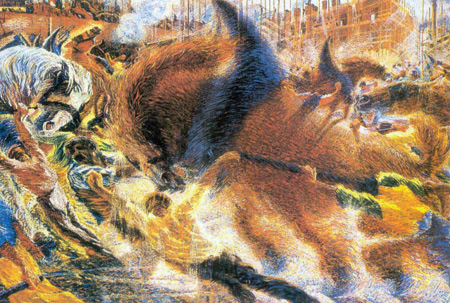
Futurism later absorbed by the very museum system it originally sought to overturn.
The largest act of censorship in visual art in the twentieth century took the form of an exhibition: the Nazi exhibition Entartete Kunst (Degenerate Art), held in Munich in 1937. Designed to ridicule and denigrate works that did not conform to National Socialist ideology, it was visited by over two million people. Two years later, more than a thousand confiscated works were burned in Berlin.
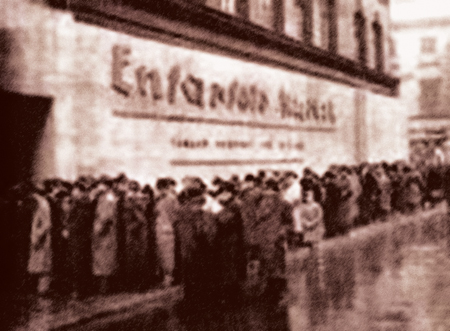
Censorship enacted through display: ridicule, framing, and mass visibility as instruments of power.
After World War II, the European art scene was largely dominated by languages imported from American art of the 1940s and 1950s. In the context of the Cold War, Abstract Expressionism was promoted as a symbol of Western freedom.
In the 1950s the most influential art critics were Clement Greenberg and Harold Rosenberg, both of Jewish origin and associated with a non-figurative culture. In December 1950 Clement Greenberg joined the CIA-fronted American Committee for Cultural Freedom. In the Cold War context, Greenberg—benefiting from significant funding—promoted Abstract Expressionism as cultural propaganda, presenting the USA as the guardian of “advanced art.”
Harold Rosenberg coined the term Action Painting in his essay “American Action Painters” (ARTnews, December 1952). The ambiguous title refers both to American “action painters” and to a wider ideological framing that credited the USA as the new center of international culture. The art system progressively took shape as a network of artists, critics, curators, galleries, museums, collectors, and sponsors—capable of producing both symbolic and monetary value.
With the fall of the Berlin Wall, ideologies formally came to an end—except for the ideology of the market. The contemporary art system became fully structured and market-oriented. Exhibitions increasingly assumed the role of sense-makers, while artworks became the “words” of a “statement” conceived by a curator.
The elements of the art system are artists, critics, galleries, curators, museums, and collectors. When these entities are linked to one another, the art system is ready to produce “value”—not only artistic value, but monetary value as well.
Through this process, curators assume a role never seen previously: not only specialized personnel with art-historical formation, but also theorists, organizers, and “authors.” One could recall Foucault’s idea that the “author” does not precede the work, but functions as a principle that limits, excludes, and selects— a means through which free circulation and recomposition may be constrained in order to achieve a proposed thesis.
Supplementary formats such as catalogues, magazines, reviews, and institutional texts grow in importance with the rise of the art system. The framework of these formats adds aura or mythic value to artworks, just as exhibition in museums and galleries adds value to the artworks themselves. Financial institutions, banks, and insurance companies become partners and sponsors of museums, alongside collectors. At times the mix generates even forms of insider advantage, as in The Upper Room (3), an installation of thirteen paintings of monkeys by Chris Ofili. The work was bought by Tate and caused a media furor after a campaign initiated by the Stuckist art group, because Ofili was on the board of Tate trustees at the time of purchase. In 2006 the Charity Commission censured Tate for the purchase, but did not revoke it.
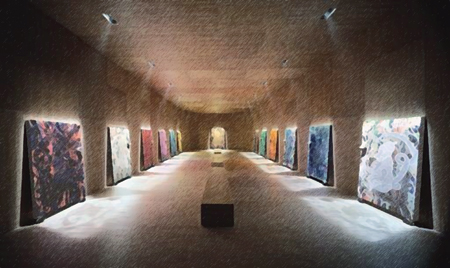
Institutional self-legitimation and conflicts of interest: visibility as value-production.
At the 2009 Venice Biennale, one of the more surprising decisions was the selection of Liam Gillick, an English artist, to occupy the German Pavilion. Walter Börnsen, culture spokesman for the German Christian Democrat party, condemned the decision. The selection of Gillick was made by the German Pavilion curator Nicolaus Schafhausen, who had curated Gillick’s mid-career retrospective at Witte de With Center for Contemporary Art in Rotterdam the year before.
Another controversy involved a sculpture by Charles Ray at Punta della Dogana, one of the most scenic places in Venice. The sculpture was exhibited as part of the personal collection of the fashion tycoon François Pinault, who obtained the venue on a long-term loan. According to Charles Ray, Boy with a Frog (4) was inspired by Mark Twain’s descriptions of the Mississippi River. Many observers asked: if the Mississippi is the origin, what is Venice doing here?
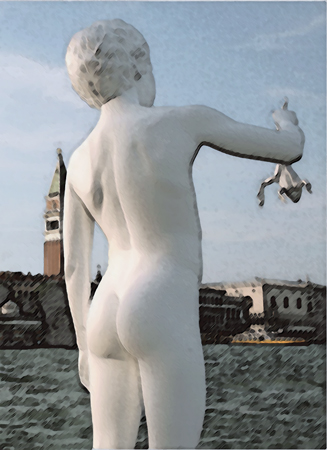
Symbolic placement, patronage, and the politics of location in the contemporary art landscape.
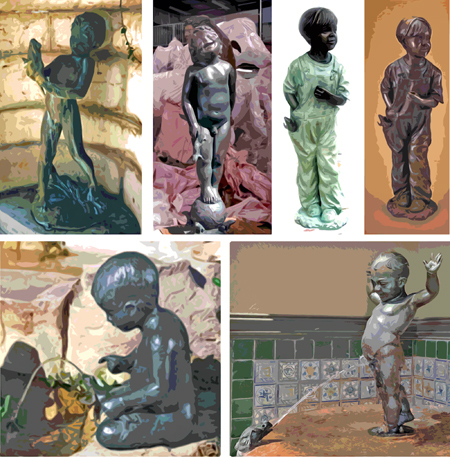
A recurring public iconography later re-activated in contemporary contexts.
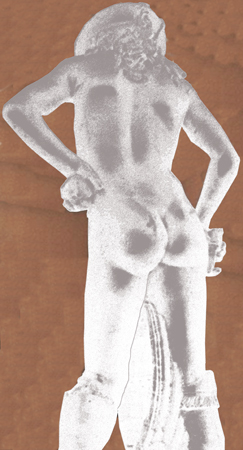
Historical precedent repeatedly invoked in modern debates on the body, display, and public reception.
In contemporary art and in a globalised world, the distinction between art and fashion becomes increasingly cloudy—and in this way art risks loosening its function. Fashion is concerned with the appearance of reality and works on the surface of existence. The search for what lies behind the continuous flux of appearances has always been a purpose of art.
Art itself cannot be censored. What can be censored is its visibility. Power today operates not only by prohibiting, but by determining what is allowed to appear, where, and under which conditions of legibility.