

The earliest figurative representations of “Buddhist” art appear in the bas-reliefs of the railings that surrounded the stupas of Bodh Gaya and Bharhut.
Of the first we know that it was built in a period very close to that of Ashoka.
The railing of the Bharhut stupa was erected by a prince named Vatsi-putra Dhanabuthi of the Sunga dynasty; it was therefore built at a later time than Ashoka’s. About one hundred bas-reliefs are carved on the stones of this railing, and the names of the depicted figures as well as the title of the legend or Jataka are also inscribed.
Another major testimony of “early Buddhism” is found in the bas-reliefs on the toranas (gateways) of the enclosure of the Great Stupa at Sanchi, built at the time of Ashoka, around 250 BC. The construction of the enclosure and the toranas required more time; an inscription on the southern gateway states that it was erected during the reign of King Satakarni around 155 BC.
The upper part of the railing at Bodh Gaya is ornamented on its inner faces with long rows of elephants, deer, makaras, and other animals, and on the outer faces with garlands of flowers. In the bas-reliefs of Bharhut and Sanchi we find a detailed documentation—rendered with truly convincing realism—of the customs and daily life of India at that time.
The distinctive feature of these representations of “early Buddhism” is the absence of the figure of the Buddha. One who has been freed from “name and form” cannot be represented; the presence of the Enlightened One can only be testified through symbolic forms. In one scene Ajatasatru—the king during whose reign the Buddha attained Nirvana—bows before an altar upon which the footprints of the Master are impressed: a way of affirming—literally—one’s determination to follow in his footsteps. In the scene in which Siddhattha leaves his home, we see the faithful servant Channa and the Devas lifting the horse Kanthaka so that no sound is produced by its hooves; on the horse’s back no man is depicted, but only the parasol of authority. At Sanchi, the most frequent representation is the Buddha in the form of a tree; and in one bas-relief an inscription reminds us that it is the Bodhi tree of Sakyamuni.
The anthropomorphic representation of the Buddha begins in the first half of the 1st century BC, when the Theravada tradition starts to fade and Mahayana begins to flourish. With the advent of this new tradition, the intellectual discipline achieved through the practice of Vipassana—which had characterized the Dhamma and formed the core of the early disciples’ speculation—begins to dissolve in favor of a spirit of devotion expressed in the creation of a cult. The deeply human need for divinities able to bestow compassion upon all who seek their help lies at the origin of the cult of personified deities—humanizing the divine.
It is an idea that has remained alive over time. André Gide, in his diary (1939–1942), wrote on June 14, 1940: “We are inexorably sunk into matter, and even our spiritual loves cannot do without a material representation...”
The earliest statues depict the Buddha seated in meditation; certainly correct mental discipline—Samma Samadhi—the foundation of the introspective process through which one learns to develop equanimity—Upekkha—underlies the visible icon.
From an iconographic point of view, the seated figure of the Buddha takes three fundamental forms...
In 1997 I learned about the project for the Global Pagoda under construction in Bombay...
In 1998 Corrado Pensa, a professor and scholar of Indian and Buddhist culture, expressed the wish to have an image of the Buddha for the Rome center...
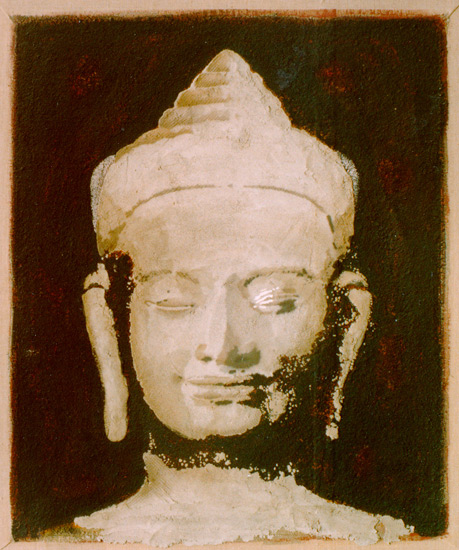
The image that inspired me is not a monumental statue, but the fragment of a bust, in Bayon style...
Darkness, silence, and emptiness are themes of great interest for contemporary art—and also categories of Vipassana practice.