

Not gestures to assert, but silences to hold.
Fabrizio Ruggiero
During his formative years in Naples, Fabrizio Ruggiero’s encounter with the frescoes of Pompeii offered him a form of wonder that, in ancient Greek thought, coincides with the very origin of knowledge. This foundational experience was accompanied by his studies of the Bauhaus during his time at the Faculty of Architecture, which early on oriented his reflection toward the relationship between structure, surface, and perception. From this point, a research trajectory began to unfold—one that would develop over time as an inquiry into the nature of the image, understood not as a mere visual phenomenon, but as a site of awareness, responsibility, and relation.
Extended periods spent in Asia deepened his engagement with Indian thought and Eastern philosophical traditions, opening his practice to an intercultural and symbolic dimension. From these experiences emerged a reflection on visual structures that traverse cultures, later articulated in the graphic series Family Resemblance, in resonance with Ludwig Wittgenstein’s reflections on similarity, difference, and the invisible systems of relations that bind forms together. The work thus takes shape as an investigation into the deep analogies that permeate symbolic languages and structures of thought.
In 1984, he settled in Tuscany, where he founded Architectura Picta, an experimental laboratory dedicated to rethinking fresco not as a technique belonging to tradition, but as a contemporary language and a critical device. Within this context, fresco emerges as a field of research: a practice capable of reintroducing duration, irreversibility, and material responsibility into the image, while exploring the internal structure of form and the very time of its appearance. Fresco thus becomes not only an expressive medium, but a method of thought and an instrument for interrogating the relationship between image, time, and presence.
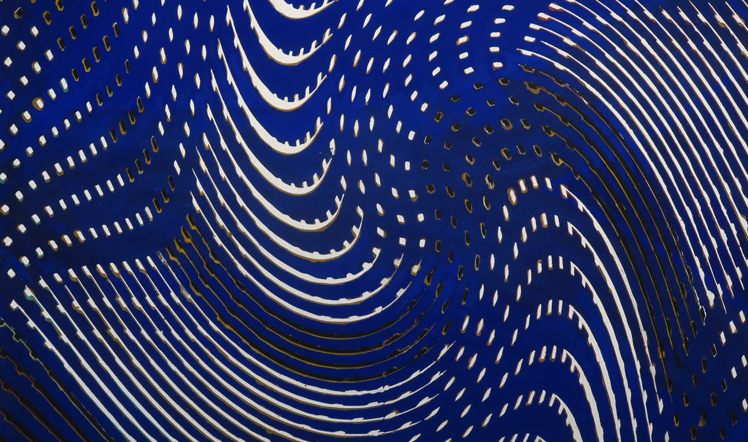
Over time, Fabrizio Ruggiero’s work has increasingly focused on the relationship between form, matter, and space. His sculptural research develops through processes of modeling and construction, often employing cane mat, lime, and plaster, in search of a delicate equilibrium between weight and lightness, permanence and fragility. In parallel, portraiture emerges as a central axis of his practice: the human face is approached not as mimetic representation, but as a symbolic territory, a site of civic memory and archetypal presence. The portrait thus takes the form of an effigy, capable of condensing individual identity and collective dimension.
His projects frequently unfold at the intersection of art, architecture, and symbolic space. In 2001, he collaborated on the Global Vipassana Pagoda project—a monument to peace, harmony, and meditation—near Mumbai.
In 2006, The Summer Triangle — Orpheus, Deneb and Altair was awarded for the redevelopment of the Raggiolo tunnel in Tuscany. In 2010, within the former church of the Castle of Poppi, he presented A Bruit Secret & Pandora’s Box, a reflection on modernity through portraits of ten artists, where the dialogue between image, absence, and memory becomes both curatorial device and space of critical inquiry.
In 2014, he realized the permanent installation Tribute to Traditions: Cultural Diversity in Unity at the National Museum of Cameroon in Yaoundé. The work testifies to the dialogue between cultures and recalls the friendship between the explorer Pietro Savorgnan di Brazzà and Makoko Iloo I, sovereign of the Batéké and a major spiritual leader of Equatorial Africa. The project reaffirms the principle of recognizing the full humanity of every individual, regardless of geographical or cultural origin, transforming historical memory into a contemporary reflection on dignity, coexistence, and ethical responsibility.
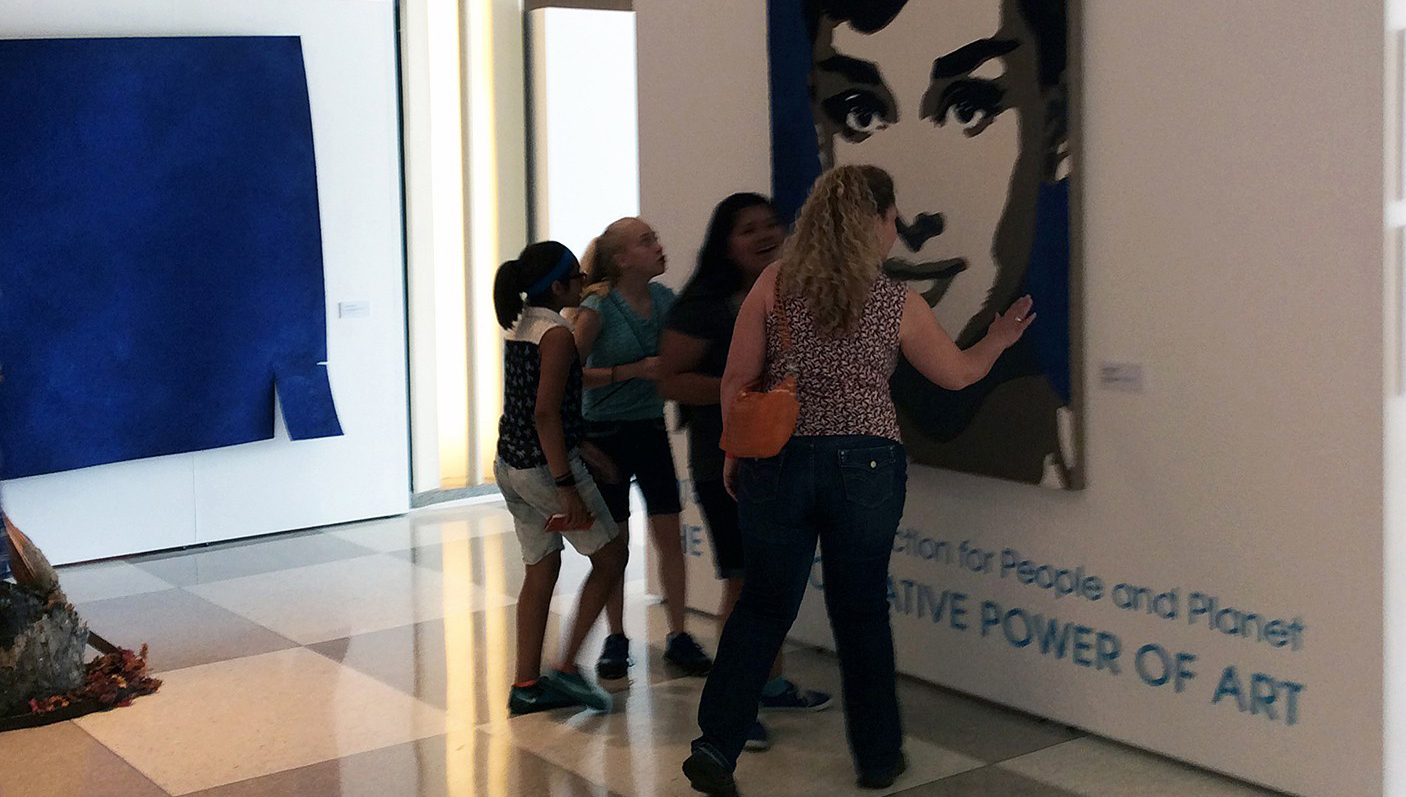
In 2015, he presented Le Monde des Femmes in Paris, an exhibition project dedicated to female figures who, through their human, artistic, and civic trajectories, contributed to transforming the idea of full humanity into a concrete universal principle. In this context, Ruggiero presented a series of stylized portraits dedicated to figures such as Gong Li, Lady Diana, Louise Bourgeois, Malala Yousafzai, Miriam Makeba, Oum Kalthoum, Joan Baez, and Maya Angelou. Diverse in origin, language, and history, these figures share a symbolic force that transcends individual portraiture to assume a universal dimension. The face becomes an effigy and a site of cultural memory, where personal identity and collective imagination converge.
In the same year, the major exhibition The Transformative Power of Art was presented at the United Nations Headquarters in New York. The project brought together large-scale sculptures and sixteen fresco portraits in a reflection on tolerance, cultural diversity, and the transformative power of the image. The exhibition was subsequently presented at the Casa Italiana Zerilli-Marimò at New York University.
With The Transformative Power of Art and Ideas (2017), presented at Villa La Pietra, New York University’s Florence campus, this vision was further expanded, articulating the idea of art as a space of reflection, awareness, and transformation, capable of activating a profound relationship between aesthetic experience and ethical responsibility.
In 2022, he created a series of portraits of composers in support of and in collaboration with the Anghiari Music Festival, continuing his investigation of portraiture as effigy and symbolic presence, where the face becomes a cultural archive and a form of permanence.
Today, he continues his artistic research primarily in his studio in the hills surrounding Anghiari, Tuscany, where fresco, sculpture, and portrait coexist as practices within a unified reflection on time, matter, and the capacity of the image to generate consciousness. Within this perspective, the work emerges as an exercise in attention and responsibility—one that recognizes its own limits and, precisely for this reason, opens itself to the complexity and mystery of the world.
.jpg)