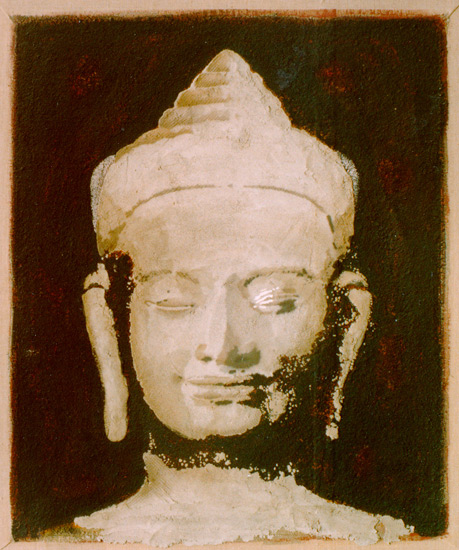
Research Node · Iconography · Meditation · Presence / Absence
This node investigates the emergence of Buddhist iconography, focusing on the transition from symbolic absence to anthropomorphic representation.
The image is approached as a threshold between visibility and withdrawal, between form and silence.
Fabrizio Ruggiero, Colossal Head of Buddha, fresco on panel, 160 × 130 cm, 2004.
Historical Timeline
3rd century BC — Ashoka and early Buddhist monuments
2nd–1st century BC — Symbolic (non-anthropomorphic) phase
1st century BC — Emergence of anthropomorphic Buddha
2nd century AD — Monumental statuary (Anuradhapura)
5th–7th century — Bamiyan, Yungang, Kamakura
The earliest figurative representations of Buddhist art appear in the bas-reliefs of Bodh Gaya and Bharhut.
The distinctive feature of early Buddhism is the absence of the Buddha’s figure: one who has been freed from name and form cannot be represented.
The anthropomorphic image emerges later, with the rise of devotional structures and the human need to relate to a visible form.
This passage from absence to presence is not merely historical — it reflects a transformation in the relationship between perception and consciousness.
Darkness, silence, and emptiness are not negations, but operative fields — conditions through which perception is suspended and reconfigured.
“Darkness, silence and emptiness are not absences, but fields of awareness.”