

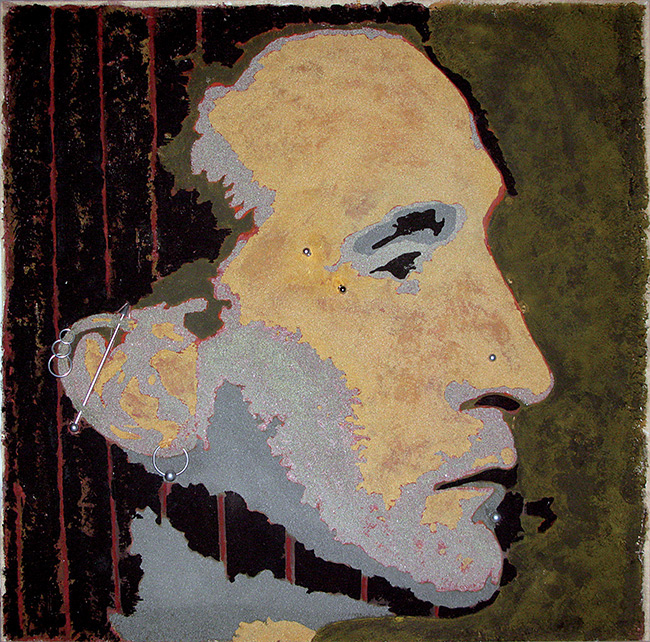
Through the effigies of ten modern artists, A Bruit Secret & Pandora’s Box stages a meditation on the visible and the invisible, on the persistence of the image and on the possibility of interrupting mechanical thought, even if only for a single moment.
The project takes its title from Marcel Duchamp’s À bruit secret, transforming the idea of hidden sound into a visual and mental device. The installation does not illustrate art history; rather, it summons a constellation of figures whose works have redefined the conditions of modern vision.
| Joseph Beuys | Shamanism, art as the science of freedom. |
| Constantin Brancusi | The quest for the essence of form. |
| Alberto Burri | The colours of substance, the substance of colours. |
| Giorgio De Chirico | The enigma of the unknowable. |
| Edgar Degas | The flexible precision of drawing. |
| Vasilij Kandinsky | Listening to form and inhabiting it with all the senses. |
| René Magritte | Logic within the poetry of the absurd. |
| Henri Matisse | The arabesque and the cut-outs. |
| Pablo Picasso | From trompe-l’œil to trompe-l’esprit. |
| Marcel Duchamp | A taste for disguise and a distaste for the smell of turpentine. |
The installation was conceived specifically for the spatial and symbolic dimension of the small deconsecrated Church of San Lorenzo in Poppi, a place that had already been used as an exhibition space for contemporary artists. Its architecture retained the memory of sacred use, while opening itself to a secular meditation on modernity.
Ruggiero placed A Bruit Secret & Pandora’s Box in the large niche above the altar, transforming the site into a theatre of another kind of sacrality. The portraits become contemporary icons: not objects of devotion, but thresholds through which the viewer is invited to suspend habitual perception and encounter painting as a field of mental resonance.