

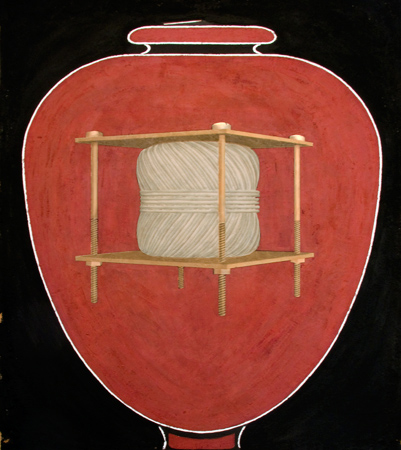
In Greek mythology, Pandora opens a sealed vessel — later interpreted as a “box” — from which all the evils of the world escape. The myth stages a drama of curiosity and consequence: what is contained is invisible, what is released irreversibly transforms the human condition.
By inserting Marcel Duchamp’s A Bruit Secret into Pandora’s vessel, Fabrizio Ruggiero performs a symbolic displacement. Duchamp’s ready-made produces a sound when shaken, yet its cause remains unknown.
This gesture becomes a metaphor for contemporary art itself. The artwork emits signals — meanings, affects, provocations — yet their origin is no longer anchored to stable traditions or shared symbolic systems.
Transposed into fresco, a medium historically associated with durability, public visibility, and sacred iconography, the ready-made is subjected to a paradoxical transformation: an ephemeral conceptual object is fixed into architectural time.
In this sense, A Bruit Secret within Pandora’s Box articulates a koan for visual culture: how can an artwork still produce meaning when the origin of meaning itself has become opaque?
.jpg)